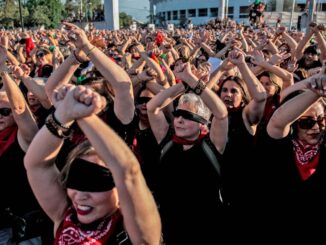

Thousands of white-clad demonstrators expected to turn out on the eve of Unasur meeting of foreign and defense ministers in Quito
Thousands of Peruvians will demonstrate Friday in Lima and Tacna against what they decry as Chile’s race to secure more and more weapons.
The demonstration is organized by Peruvian President Alan Garcia and will be led by three of his cabinet members: the Minister of Work, the Minister of Women and the Minister of Development.
“This is a march for peace,” said event organizers. “Our nation doesn’t believe in the need to arm itself, or the need to aggressively dissuade others. And certainly not in spying. These are not things that a nation concerned about progress would do.”
Peruvian president Alan García has taken full advantage of the espionage controversy. Photo courtesy of Mercopress
The march will occur the same day that defense and foreign affairs ministers gather at the Unasur meeting Quito. Unasur members include Argentina, Brazil, Chile, Colombia, Ecuador, Guyana, Paraguay, Peru, Surinam, Uruguay and Venezuela.
Chile’s government last week denied Peru’s spying allegations and insisted the issue will be included on the Unasur agenda.
“Unasur does not have the issue in its agenda, the issue is strictly bilateral, and we believe that is how it must be addressed,” said Chilean government spokesperson Carolina Toha.
But Ecuadorian Foreign Affairs Minister Fander Falconi said last weekend that both the spying allegations and the political conflict between Colombia and Venezuela would be discussed at the Unasur meeting.
Peru claims it captured “red handed” a Peruvian Air Force officer who was passing sensitive data about his country’s armed forces to a Chilean contact. Peruvian official Victor Ariza Mendoza was on the “Chilean payroll” since 2004 and received US$3,000 monthly, alleged Peru’s government.
Peruvian authorities said they have additional information about the spy network, but will only reveal it once Chile agrees to a full judicial investigation to expose the network’s participants.
Relations have historically been tense between the two countries, ever since Chile occupied Peru during the War of the Pacific and annexed mineral rich northern territories.
More recently, Peru has repeatedly accused Chile of promoting an arms race by its decision to spend billions of US dollars in military hardware for its military. New Chilean armaments include German tanks; US F-16 fighter planes; British frigates, French submarines and, most recently, US air to air and sea to air missiles.
SOURCE: MERCOPRESS, LA TERCERA
By Santiago Times Staff (
This e-mail address is being protected from spambots. You need JavaScript enabled to view it
)
Chinese
Is Alan Garcia a serious President?
No
Is Peru a credible country?
No
Is ceviche solely the property of Peruvian Gastronomy?
No
Is Pisco purely Peruvian?
No
etc etc.
In Chile We have Lucuma, Pisco, Ceviche. and many other things.
Peruvians need to realize that not everything is Peruvian.
said Anthony Bourdain
enough said
If a country could use a good "shrink," Peru may top the list.
If you have ever traveled through South America, chances are that your flight connections may have taken you through the state-of-the-art Lima airport. If you were lucky, you may have been able to visit the beautifully manicured Lima suburb of Miraflores, or the bustling port of Callao. If you're like me, what strikes you is how contemporary this country appears to be.
The Santiago Times reported today (Peru To Protest Chile Arms Purchases, Dressed In White) that thousands of (private citizens) will demonstrate against Chilean military expenditures in the streets of Lima and Tacna.
The last time I checked, the Wars of the Confederation and the Pacific occurred in the 19th century. Briefly, Latin America followed the lead of the American Revolution in the north and took advantage of Napoleon's disruption to Spanish harmonium in Europe. Simón Bolívar (El Libertador and admirer of Thomas Jefferson) is credited with liberating Peru in 1824. Around 1830'ish, Peru conspired with neighboring Bolivia to undermine the economies and sovereignty of both Chile and Argentina. This led to Chile kicking Peru's butt in the War of the Confederation. Not long after that, 1879-'80's, Chile once again handed Peru and Bolivia a decisive defeat in the War of the Pacific. Having forgotten the lessons of the previous encounter of the 1830's and with the loses that Peru (and Bolivia) encountered in the latter conflict, I can understand the benefits of acquiring the memory of an elephant.
Ok, so much for lessons learned. Chile is a sovereign nation and fully capable of defending their right to self-determination. Get over it, Peru. What makes me think that Peru needs a shrink is that their President, Alan Garcia, is exhibiting symptoms of paranoia-schizophrenia over Chilean military expenditures. Does Garcia really believe that Chile intends to invade Peru? The fact that (Peruvian) civil demonstrations over Chilean arms purchases are scheduled in Lima and Tacna warrants concern. Remember, the Battle of Tacna (also known as the Battle of the Halt of the Alliance) consolidated the Chilean domain over the Tarapacá Province. Choosing the border town of Tacna for the demonstrations should (justifiably) be considered provocative to Chile. Either Peru is still fighting 19th century conflicts or acting as pawns to the more liberal socialist forces of the region.
Either explanation of these planned provocations is congruent with Chilean-Peruvian history. Peru has not seemed to have evolved beyond their 16th century role as one of the four Spanish Vice-royalties.
Viva Chile!
Viva Chile!